Business

How to apply for a startup business loan in India?

Startups require more than a business product or service idea to bring their name to the market. Entrepreneurs’ lack of funding or capital is one of the greatest challenges they have to overcome to turn their idea into reality. It is also viable for startups to take out a business loan to expand their business. 

We know how important funds are to keep the business running, particularly startups that don’t have backup

Ready to take your startup to the next level?
Apply for a startup business loan in India with ease!

To help you, we have compiled a comprehensive guide on how to get funding for startups.

Step-By-Step Instructions To Apply For Startup Business Loans

Here are 6 step processes to apply for the business loan for your startup business. 

1. Draft a business plan

This document is a road map to your business’s success, including the business financing you’ll need. Many ways exist for you to help lenders evaluate your business, such as an outline of how you will fit into the market, attract customers, make money, etc., to see how your loan fits into your situation. 

The lender is most interested in your working capital, market growth potential, and revenue plan. Keep this in mind because lenders are most concerned with your financial picture. You should write as much detail as possible to show that you will be a good borrower.

2. Choose the type of business loan

After completing your business plan, you are embarking on the next step to prove to potential lenders that you will be a great borrower. It’s time to decide which financing options for startups you apply for. After all, wouldn’t you like to ensure you can meet the loan terms. Startups have many options for business loans.

Traditional loans through a bank are more likely to offer you the best rates if you qualify. 

In contrast, traditional bank loans are hard to qualify for startups. If you cannot borrow from your bank, consider an online lender, which is a good alternative. 

3. Check your credit score

Lenders evaluate applicants’ credit scores to determine whether they represent a high or low risk. Higher credit scores are a better indicator of people who are more likely to pay on time and, consequently, have higher chances of being approved. In most cases, credit scores are seen as available within six months to one year after a business has been opened, so a new business may not have one, especially if it is a brand-new business.

However, it is important to remember that loans are often guaranteed by the borrower, meaning that if the business cannot repay the loan, the borrower will be liable to repay it with their funds. Therefore lenders also look at the credit score of the applicant/business owner personally.

It is important that before you apply for a loan, you review your business credit report and check your credit score so that you can be prepared for the loan application process and gauge your chances of being approved.

4. Make a list of lenders and compare them

Depending on your personal and business qualifications, a startup loan may be available through various lenders. When searching for a startup business loan that fits your needs, then take into consideration the following factors when comparing lenders:

  • Rates on an annual basis

For the most part, business loans start at around 9% APR, though business startup loans may have higher APRs, and rates may be even lower for the most qualified applicants for business loans. Find out what the APR of each lender is by visiting the lender’s website or by contacting their customer service department.

  • Fees and other costs

There are typically origination fees charged by business lenders that range from 3% to 5% of the loan amount, which covers the costs associated with handling paperwork and verifying the application information provided by the applicant. 

As well as prepayment penalties, some lenders charge late payment fees to borrowers who miss their monthly payment deadline and prepayment penalties to those who pay off their loans early. 

As a result, these fees can increase the cost of borrowing, which is why some lenders remove them to stay competitive.

  • Lender reputation

The most important thing to remember when looking for a lender is to read reviews online about the lender, no matter how good it appears on paper. 

Similarly, you should contact other business community members to find out about their experiences with the financial institution before deciding. 

If you encounter any red flags in your research, such as negative experiences with their customer service department, consider choosing another lender.

5. Prepare the list of documents required

Depending on the lender, the documents required to apply for a business loan may vary. While the majority of lenders use some documents to assess and verify an applicant’s identity, as well as the existence of a business, there are some documents that they always require.

 As a startup founder, you can enhance your chances of acceptance by drafting a comprehensive business plan. Based on the revenue and expense projections for the future, this can serve as a useful tool for lenders to demonstrate the business’s financial stability. 

In addition, lenders may also request that you submit copies of licences and registrations relating to your business, industry, or product, as well as banking information, so that direct deposits can be made.

6. Submit

When deciding on a lender, ensure you are familiar with the application process and have gathered the correct documentation before applying. 

There is a difference in the application and underwriting process between lenders, so check with them whether you can apply online, via telephone, or if you must visit a branch. 

A lender representative may contact you after you submit your application to obtain additional documentation, such as proof of collateral or financial records, which may be required for the loan application.

Are you interested in learning the steps of applying for business loan without ITR? Then you can refer to our detailed guide: How to Apply for a Business Loan without ITR?

Also Read: 9 Different Types Of Business Loans In India

Ready to take your startup to the next level?
Apply for a startup business loan in India with ease!

Conclusion

It may seem daunting to find financing for your newly established business. But if you have a detailed plan, you will be in a better position to apply for a loan, choose a loan that fits your needs, and follow a payment schedule. You can take your startup to great heights with the help of the much-needed funding you receive.

Still, if you can’t approve the loan, we at Real Money Solutions can assist you in getting the loan for a small business in Mumbai.
Business

Primary Differences Between Cash Credit And Overdraft

As a business owner, you must be aware that several factors contribute to the smooth functioning of your business operations and ensure your business’s success. Capital is the most significant factor among all the factors responsible for keeping a business running smoothly. To run a successful daily operation, both small and medium businesses need access to a certain amount of capital from time to time. Even though there are several ways for a business to procure capital, cash credit, and overdraft facilities are the most popular.

The problem is that most people tend to confuse them or think they are the same thing.

Unsure of the difference between Cash Credit and Overdraft?
Let us help you make the right choice for your financial needs!

This guide will help you determine the difference between an overdraft and cash credit to make a more informed decision about your business.

A] What Is Cash Credit?

A Cash Credit (CC) loan is offered to self-employed professionals and business owners to ensure they can pay their operational expenses.

B] What Is Overdraft?

The bank provides its customers with an overdraft (OD) credit facility. With the OD facility, current account holders can withdraw money from their bank accounts regardless of their balance, even if it is extremely low.

OD against FD is a common type of overdraft facility that allows customers to borrow against their fixed deposits held with the bank.

C] Primary Differences Between Cash Credit And Overdraft

When it comes to the financial needs of your business, you should always choose the right solutions including credit facility. Choosing the right credit facility is imperative to manage your business affairs effectively.

Understanding the difference between OD and CC can significantly change the odds in your favour.

Parameters Cash Credit  Overdraft
Purpose The cash credit loan facility is a good way for businesses to obtain working capital when required. The overdraft facility allows individuals and businesses to meet short-term financial obligations.
Basis An organisation’s stocks and inventories determine whether it can get a cash credit loan. The overdraft facility provided by a bank is governed by the applicant’s relationship with the bank (such as the investments, the type of account they hold, etc.)
Interest rate There is a lower interest rate on cash credit than on overdrafts It is necessary to open a new account to receive the cash credit loan amount.
Set up an account. It is necessary to open a new account to receive the cash credit loan amount. No need to create a new account. Since overdrafts are available to existing customers.
Duration of the loan The repayment period for a cash credit loan is usually one year. The repayment tenure for overdraft facilities is usually available every month, every quarter, on a half-yearly basis, or an annual basis.
Loan Amount Throughout this financing agreement, the sanctioned amount does not decrease. Overdraft amounts decrease monthly on overdraft facilities.

This is a more detailed explanation of how they differ.

1. The Purpose Of Financing

There is a considerable difference between cash credit and overdraft that is centred on the purpose of each of them. It is important to note that a cash credit option is only available to businesses to meet their working capital requirements.

As opposed to this, funds obtained through overdrafts are not restricted in terms of how they can be used. Therefore, it can be used for personal and professional purposes to finance your needs.

2. Loan Amount Availability

In the case of a cash credit that is available in exchange for the hypothecation of inventory, the loan amount that can be obtained entirely depends on the amount of stock the business has maintained when the loan is requested.

There is no set amount you can borrow for an overdraft facility. In many cases, you can borrow a certain amount depending on your credit history and your past relationship with the bank. It is, therefore, the point at which overdrafts in banks are distinguished from cash credit in banks.

As far as overdraft facilities are concerned, the number of funds you can avail of will be directly related to the value of the asset you will be using as collateral to provide security for the overdraft facility.

3. Withdrawal facilities

Among the other significant differences between overdraft vs cash credit accounts is the withdrawal facility they offer, which is provided for both accounts. The cash credit option allows you to receive funds at a time following the approved amount. In contrast, the overdraft facility allows you to withdraw funds in multiple amounts based on the total amount available.

D] Are there any similarities between cash credit and overdraft?

Yes. Despite their differences, cash credit and overdraft facilities do share some similarities. And while it is essential to understand the difference between the two, let’s not overlook the similarities, they are just as crucial.

1. The Maximum Amount

It should be noted that the maximum sanctioned amount under both financing arrangements is fixed and that further financing cannot be approved.

2. Repayment

Cash credit loans and overdraft facilities are repayable on demand, whether based on a credit card or a bank account. The prepayment fees for these two types of financing options do not apply to either of them.

Unsure of the difference between Cash Credit and Overdraft?
Let us help you make the right choice for your financial needs!

Conclusion

We hope that we have cleared up any confusion you had regarding cash credit and overdraft. Similarly, if you have trouble understanding the difference between overdraft and business loan, You can refer to our guide: Understanding Business loan vs. Overdraft: Which to choose?

Moving on, for small businesses concerned about short-term financial pressures, overdrafts, and cash credit are great alternatives to meeting those pressures. In contrast, if you seek a long-term business loan to cover your current business needs, consider applying for one.

If you’re starting a new business or thinking of expanding your existing business taking it to new heights, you may require some monetary help.  This is where loan agencies come in handy. You can look for reputed Loan Consultants in Mumbai. They can help you find loans suitable for your business needs.

We guarantee you will not have to cut back on essential expenses by providing a competitive business loan rate. We also offer services for business loan Mumbai. You can always feel free to reach out to us and we can assist you in your objective to grow your business, helping you reach new heights of success!

Business

How to get a Business Loan under CGTMSE Scheme without Collateral?

Founded in 2000 by the Small Industries Development Bank of India and the MSMEs, the Credit Guarantee Fund Trust is an initiative of the Government of India to provide credit guarantees to micro and small-sized businesses.

Those startup companies need funds to gain a strong foothold in the market. Collateral-free loans under CGTMSE scheme act as guarantors for business loans, helping business owners get financing.

To understand and benefit from the CGTMSE loan for new business, every entrepreneur and business owner in India must understand its importance. The availability of investment capital, whether debt or equity, is crucial for a company to launch and manage successfully, and the CGTMSE scheme has made it easier to access financing.

We will explore the CGTMSE Scheme, loan types, and how business loans can be obtained.

Don’t let a lack of collateral hold you back from growing your business.
Our team of experts can help you understand the eligibility criteria and guide you through the application process.

A] About CGTMSE

The government of India has established the CGTMSE program to provide guarantees to micro and small enterprises to facilitate their access to banks so they can start up financially sustainable businesses.

The scheme allows first-generation entrepreneurs to achieve their entrepreneurial goals through a credit framework. Further, this facility facilitates a smooth flow of funds to MSEs by reinforcing the credit funding mechanism.

The Credit Guarantee Trust’s responsibility is to recover the lender’s loss up to 85%, depending on the extent of the failure, if an MSE fails to meet its obligations. The program does not fund business startups involved in retail, trade, agriculture, education, or self-help organizations.

B] Features of CGTMSE

The CGTMSE Scheme has the following features:

  • Selected banks and NBFCs are eligible for the guarantee cover.
  • Working capital and term loans are both considered.
  • A maximum of INR 2 Crores in credit facilities is available to new and existing MSEs.
  • The guarantee coverage offered by CGTMSE is up to 75%-85%.
  • The scheme covers manufacturers and service providers.
  • RBI guidelines set interest rates.
  • Lenders may lend Rs.1 crore to revive the business units if they cannot recover independently.
  • If the credit was not recovered within three months or when the loan became non-performing, whichever came first, then CGTMSE would cover the entire loan amount, including interest.

C] Steps To Apply For A Business Loan Under The CGTMSE Scheme

The following steps must be followed to get a loan under the CGTMSE Scheme without any collateral security:

 1. Understand the business entity

Suppose you are planning to apply for a CGTMSE loan for new business. In that case, you must set up a Private Limited Company, Limited Liability Partnership, One Person Company, or Proprietorship as per the business needs and acquire the necessary tax registrations and approvals to undertake business or execute projects.

 2. Create a business plan

A market assessment should be done, and a business plan or project report should be prepared with information such as the business model, promotion profile, projected financials, etc.

Professionals with prior experience must prepare a business plan or a project report for “making the CGTMSE scheme a successful one,” where banks should place a high priority on project viability or business model validation and secure the loan facility without any collateral requirements.

 3. Get authorisation for a bank loan

To get bank loan sanction under the CGTMSE Scheme, the business plan or project report should be submitted to the necessary banks that provide loans under the Scheme. The banks providing loans under the Scheme would then approve the loan request.

Bank loans can include terms and working capital facilities when a request is made for a bank loan. A loan application will be processed and sanctioned according to the bank’s policies.

 4. Get a CGTMSE cover

When the Bank has sanctioned the bank loan, it will apply to the CGTMSE organization and acquire cover for the sanctioned Collateral-free loans under CGTMSE scheme. It is required that the borrower pay the CGTMSE service fee and the CGTMSE guarantee fee when the CGTMSE organization approves the loan.

If you are having difficulties understanding the application process, you can get in touch with reputed loan agents in mumbai. An experienced loan provider agency will have a good grasp of the process and can help understand the process swiftly.

D] Types of CGTMSE Schemes

1. Credit Guarantee Schemes For Banks

As part of its policy, the Ministry of Micro and Small Enterprises has proposed to grant guarantees to MSEs regarding credit facilities they receive from lending institutions. As a result of streamlining the scheme’s operation and thereby increasing credit flow to MSEs, several amendments have been made to keep up with the requirements of the banks and MSEs.

Based on CGTMSE’s ‘Hybrid Security’ policy, CGTMSE’s guarantee cover applies to the portion of the credit facility which is not protected by collateral security, the part not covered by the collateral security of CGTMSE.

To resolve the credit problem, lending institutions can often obtain collateral security on only a part of their credit facility, what is known as fractional collateral security. It may be possible to cover the outstanding amount through the Credit Guarantee Scheme.

As a result, CGTMSE will charge a fee on the credit facility’s principal and collateral security.

2. Credit Guarantee Fund Scheme For NBFCS

The CGTMSE developed a scheme for NBFCs to provide credit to MSEs. Towards a maximum of Rs. 2 crores, MLI will cover all loans it extends to MSE-eligible borrowers with a trust fund that will cover them all. Retail traders of MSEs have access to a maximum credit coverage of Rs. 1 Crore. Following Reserve Bank of India instructions, the fund should not be used for personal purposes.

Also Read: Top 8 Government Loan Schemes for Small Businesses in India

Don’t let a lack of collateral hold you back from growing your business.
Our team of experts can help you understand the eligibility criteria and guide you through the application process.

Conclusion

Start-ups and established MSMEs can benefit from loans for MSMEs loan without collateral in many ways. As a result, if you are looking for an MSME loan, you will not be required to provide any collateral or security. There is no need to pledge your assets if you are starting up a business or expanding an existing business.

Get in touch with us if you wish to apply for a business loan Mumbai, and we would be happy to assist you.

Business

9 Different Types Of Business Loans In India

Business enterprises are built on the backbone of funding, and funding is required for every type and size of business to survive and prosper.

When you run a business in a dynamic environment today, you will often find yourself wondering and thinking of it as challenging to figure out how you will fund a particular need for your business. There’s one simple answer to your queries, business loans. Business loans are a significant source of funding.  However, finding the right type of business loan is also quite essential.

Generally speaking, the type of business loan ideal for a given business depends on the factors such as:

  • the type of assets purchased,
  • the leasing of a factory or shop,
  • the purchase of new machinery,
  • the working capital requirements,
  • basic operating expenses such as overhead and salaries, among others.

It is challenging to choose suitable business loans as they are multiple choices for every business. That is why it is essential to determine the type of loan best for you.

Also Read : Key Differences between Secured and Unsecured Business Loans

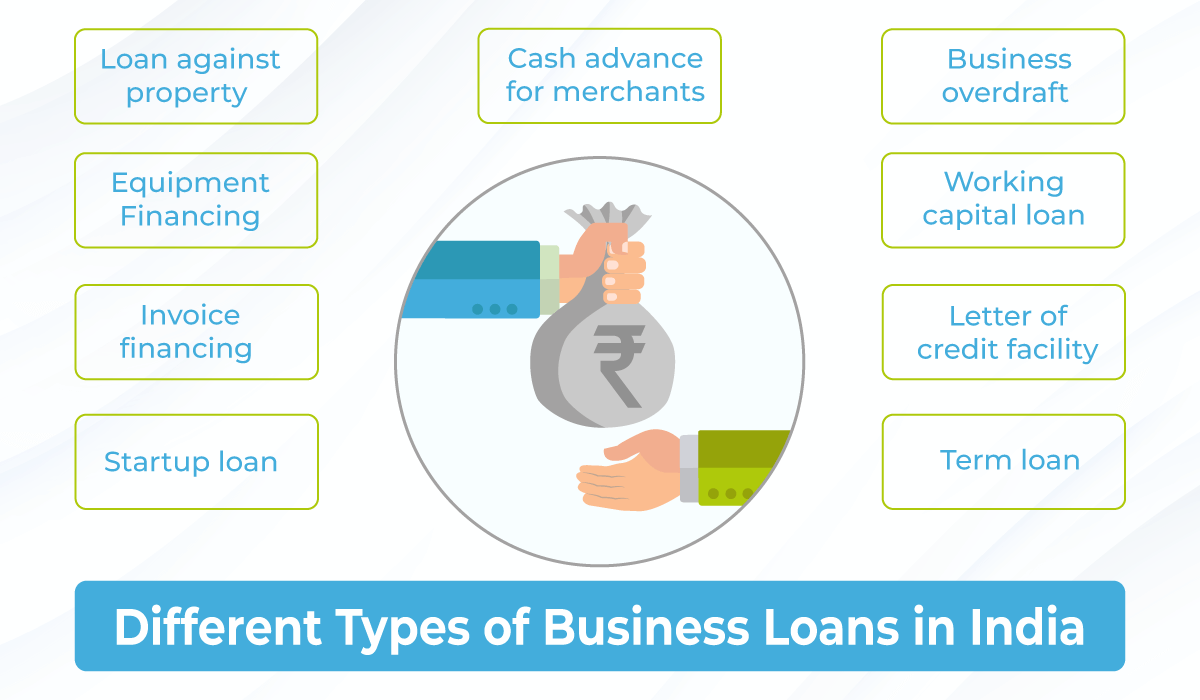
In this article, we have put together the different types of business loans in India.

Fuel Your Business Growth: Discover the Different Types of Business Loans Available and Find the Perfect Funding Option Today!

Types of business loans

Since business loans act as a backbone for every business looking to expand. Let’s have a glimpse at different types of business loans.

Businesses looking to expand tend to rely on business loans, which is why it’s crucial to understand the different types. So, let’s take a look at the 9 common types of business loans.

1. Startup loan

Start-up loans are intended for entrepreneurs planning to launch a new business venture. The applicants on this list do not have an excellent credit history, and their company does not have a track record of business performance.

As a result, when the lender assesses a business borrower’s eligibility for a business loan, they consider the borrower’s and company’s credit profile.

When determining the amount, term, and interest rate of a loan, lenders consider turnover figures and other financial facts and figures.

There is a requirement that the applicant must establish their business before they can apply for the loan. The applicant must submit proof of the existence and registration of the business at the time the application is submitted.

2. Term loan

Term loans are among the most common business loans types. It can be secured or unsecured and take many forms. The tenure of a secured loan is usually around 15-20 years; on the other hand, the tenure of an unsecured loan is generally between 1-5 years. An investment loan is a loan to finance a business’s capital expenditures and growth.

Depending on the financial history of the purchaser, the lender gives the purchaser a loan according to their requirements. Regarding the secured nature of this loan, it is backed by collateral and has either a floating or a fixed interest rate.

3. Equipment Financing

The equipment financial loans are also referred to as machinery loans and are used whenever it is necessary to borrow a large sum of money to purchase and use a little or a lot of equipment for your production. As the name implies, this type of loan is only to purchase machinery, and the loan is not counted towards the company’s growth for borrowing funds.

Whenever you take out a loan, you will need some form of security and collateral. Despite this, the interest rates on these loans are considerably lower than those on other types of loans, and the term of the loans ranges from roughly 1 to 3 years.

4. Loan against property

It is a business loan product that can provide you with a percentage of the value of your investments, such as stocks, insurance policies, fixed deposits, gold, mutual funds, etc. This type of loan can offer business owner’s up to 75% of the total investment value for the investment and does not require any other assets to be pledged as collateral for the loan.

5. Business overdraft

As a general rule, overdrafts are secured by securities or collateral, most commonly in the form of fixed deposits held with the financial institution.

An overdraft limit is approved once the lender has taken into account the credit history of the borrower, the institution’s relationship with the borrower, the business cash flow, and the borrower’s repayment history before approving the overdraft limit.

As long as the borrower takes out the amount he needs, interest is only charged on the amount withdrawn. It is permissible to use the funds in this manner as long as the principal and interest amounts are repaid according to the terms set by the lender.

6. Invoice financing

This loan can also be referred to as invoice factoring, and it is beneficial for small businesses that need a source of funding between the time they send out invoices and when they receive payments from clients. Lenders can lend up to 80% of the invoice based on the amount raised in the invoice; therefore, the amount that can be lent can be paid back over time.

Due to instant and constant cash flow, clients do not need to wait for invoices to be paid before receiving cash flow. This results in the loan repaying within a short period once the agreed repayment period and interest rate are met.

7. Working capital loan

This type of business loan is to cover business expenses on a day-to-day basis. It can be beneficial for the business to take out a working capital loan if they have several issues with their cash flow, purchasing additional inventory, managing their payroll, etc.

This type of business loan is short-term and meant to help meet your cash flow requirements if there is a delay between your payables and receivables, which can lead to an expansion of your cash flow requirements.

8. Cash advance for merchants

Here, a portion of the daily debit card sales or credit card sales is transferred directly to the financial institution as an advance on the money it has to cover its needs.

Due to this, the company must set aside a certain percentage of each day’s credit sales so the advance can be paid back over time. Enough money must be available in the borrower’s account to make the payments.

The person who receives a merchant cash advance only has to make payments based on the daily sales they make to make the payments.

As a result, you can pay back less money if the company is performing poorly, while on the other hand, you may be able to pay back more money if the company is performing well.

9. Letter of credit facility

Letters of credit are another kind of business loan frequently used in international transactions, such as import and export sales that take place on a global scale.

It is important to note here that buyers and sellers have bankers involved in the financial transaction.

The international buyer and seller are unknown to each other, so it becomes necessary to use a letter of credit to ensure the financial transaction is routed through the bankers of their respective countries. Hence, both parties have some sense of security that the transaction is being performed.

Also Read: 6+ Different Types of Unsecured Business Loans

Fuel Your Business Growth: Discover the Different Types of Business Loans Available and Find the Perfect Funding Option Today!

Conclusion

From startup loan to invoice financing, we have covered 9 different types of business loans, each of these loans come in handy in different scenarios. Emerging businesses can look into startup loans, whereas businesses looking to expand their services with new equipment can consider Equipment Financing options.

If you are considering  getting an unsecured business loan, it is also necessary to look for reputed unsecured business loan providers in Mumbai or your nearby neighbourhoods. This ensures that the loan process goes through smoothly.  Apart from business loans, Real Money Solutions also provides an extensive range of financial services to the citizens of mumbai.

Business

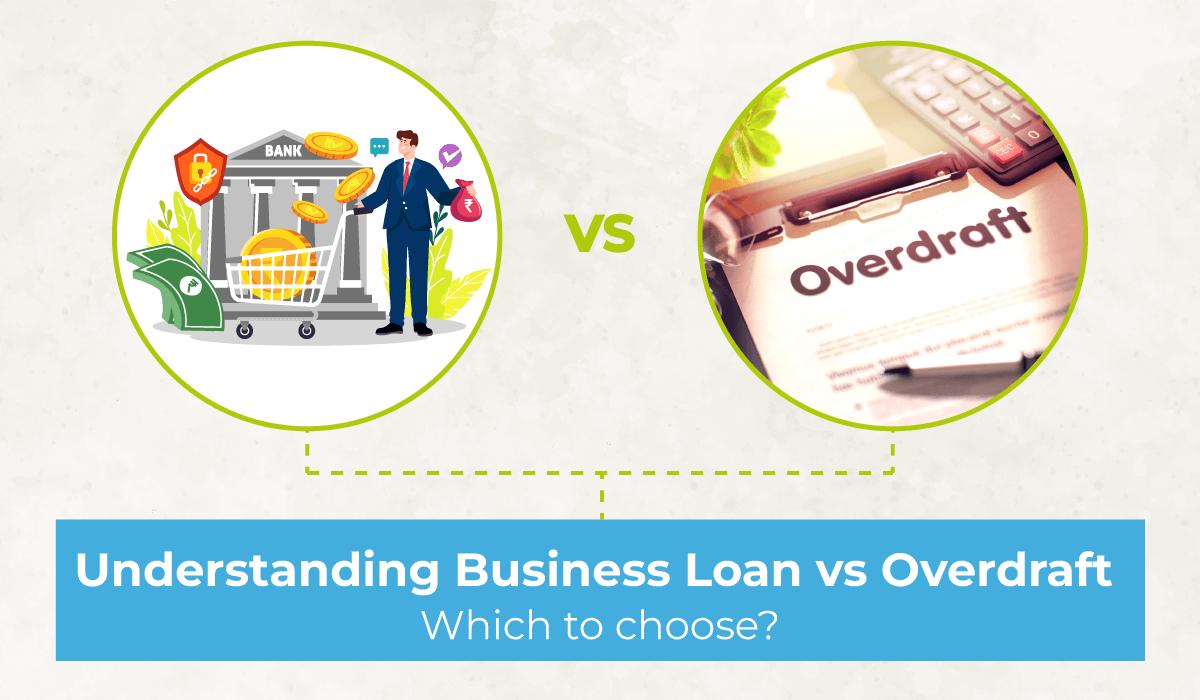
Understanding Business loan vs. Overdraft: Which to choose?

If you are planning on starting an entirely brand-new company or growing your existing business, you will need some financial help in the future.

In order to get started, begin business operations, grow, or even meet unforeseen expenses, businesses need funds regardless of industry, nature, or size.

Business loans and overdraft for business are two popular financing options. While the purpose of both financial products is to provide the borrower with funding support, the nature and features of these products differ.

So, how do you know which credit option is best for you? We’ll help you find out. Understanding the difference between business loan vs overdraft is essential to making the right decision.

Make the Right Choice for Your Business: Understand the Differences Between Business Loans and Overdrafts and Apply Now for the Perfect Funding Solution

About Overdraft

Overdraft is defined as the type of financing option available to business owners where the financial institutions or bank can offer you the overdraft facility.

It allows you to withdraw funds up to a certain limit from your current account, even if it doesn’t have enough money at the moment.

Businesses can use this financing facility to pay day-to-day expenses, like wages, etc.

Also Read: Primary Differences Between Cash Credit And Overdraft

About Business Loan

A business loan is a type of loan offered to business owners or individuals for the purpose to expand business.

It helps business owners expand their operations, meet working capital needs, get equipment or machinery, invest in infrastructure, buy raw materials or stock inventory, hire employees, and train them.

Also remember there are two types of business loans, secured and unsecured business loans.

Also Read: 9 Different Types Of Business Loans In India

Key differences between a business loan and an overdraft

Now, as you are familiar with both financing options. So to make the right choice, you must understand the differences between business loans and overdrafts.

Type Business Loan Overdraft
Definition The term business loan refers to borrowing funds from a financial institution or bank for a specific period secured by collateral (for a secured loan). Even with a zero bank balance, you can withdraw an amount
Interest rates As per the loan amount provided With regard to withdrawals
Loan Types Borrowed capital This is primarily a credit facility
Interest Rate Calculation Monthly Daily

These were just an overview of the difference between each financing option. Continue reading to get a detailed understanding of business loans vs overdrafts.

Product Nature

Business finance refers to a lump sum loan. Business loan overdrafts are one-time borrowings where a bank account is maintained, and funds are drawn up to a predetermined limit. Therefore, you can pay off the overdraft with EMIs, and the former with bank deposits.

Collateral

It depends on the loan type and whether you must pay collateral for secured or unsecured business finance. As opposed to that, an overdraft doesn’t require you to pledge any collateral as security for the loan.

An interest rate

The interest rates on your business loan are calculated monthly, and you will see this reflected in your monthly payment. Unlike overdrafts, overdraft rates are calculated day by day, which means that changes in them can be made daily.

Duration

The benefit of business finance is the ability to borrow a larger sum for a longer period, making it ideal for financing long-term goals. In contrast, an overdraft is an ideal solution for short-term financial requirements, such as a cash shortage, which may arise from time to time, and for short-term financial obligations.

Pros and cons of business loans

It is essential to consider some crucial factors before taking a  business loan. So, before making a final decision, you should consider the following pros and cons of business loans.

Pros of business loans

  • Improve Cash Flow: Irregular revenue streams are one of the small businesses’ biggest cash flow challenges. The main advantage of this type of loan is that irregular revenue streams are not an issue. If you need capital to invest in new equipment, pay payroll, or cover other expenses, a commercial business loan can help.
  • A flexible tenure policy: The loan tenure is up to you. The year-long Business Loan is an option for short-term borrowing to cover working capital expenses. To expand your business, you can take out a longer-term loan, like a four-year loan, if the loan is to grow your business.
  • No collateral is required: A business loan can be applied without requiring collateral if you meet the eligibility criteria. Small businesses with fewer assets may find business loans an attractive alternative because they are unsecured and have a higher acceptance rate.

Cons of business loans

  • Loans are not available to all businesses: The approval or rejection of business loan applications is subject to many rules and conditions set by banks. It is unlikely that all businesses will meet the financial institution’s criteria.
  • Lack of flexibility: Commercial business loans require you to know how to repay the loan and what you plan to do with the money. There are few flexibility options for commercial business loans, as opposed to merchant cash advances, business lines of credit, or equipment loans.

Also Read: Why are Unsecured business loans better for small businesses?

Pros and cons of overdraft

Pros of Overdraft

  • Compared to term loans, od loan for businessrequire less documentation and paperwork.
  • Whenever a business has incurred an expense or loss, an overdraft facility can immediately meet those expenses or losses. During busy times, it is safer.
  • Loans can be taken at any time, for any amount, up to the limit allocated, which allows for a lot of flexibility.
  • The loan does not require collateral or security.
  • Overdraft financing options are easy to obtain.

Cons of Overdraft

  • Usually, this loan covers small fund requirements, not large ones, due to its much higher interest rate.
  • Overdraft loans involve many fees, and you will be charged an arrangement fee if you want to extend an overdraft.

Make the Right Choice for Your Business: Understand the Differences Between Business Loans and Overdrafts and Apply Now for the Perfect Funding Solution

Conclusion

Customers can choose from both financial products, each with advantages and disadvantages. As long as the customer provides minimal documentation and follows a hassle-free process, they can take advantage of any credit facility they deem suitable.

If the information presented hasn’t already helped cement your decision, you can reach out to our experienced loan agents in mumbai. They’ll help you pick the right financing options. As a repeat loan provider, we offer business loans such as unsecured business loan providers in Mumbai.

Business

Why are Unsecured business loans better for small businesses?

Obtaining funds for expanding the business and growing sales is a challenge faced by many small and medium-sized businesses in India. In particular, if you are a small business owner, have no assets, and cannot borrow from a traditional lending institution, such as a bank, the odds of being approved for a business loan are nearly zero.

This is where the era of unsecured small business loans comes in. It is considered one of the safest business loans in India, and it has been a saviour for numerous small businesses.

There are several reasons why unsecured business loans for startups are gaining popularity, including the lesser requirement for document verification, flexible payment options, and no collateral requirements.

Continue reading for more information on why unsecured business loans are the best financing option for small businesses.

First, let us define an unsecured business loan before we go into the benefits of unsecured business loans.

Also Read: Key Differences between Secured and Unsecured Business Loans

Unlock the Potential of Your Small Business: Discover the Benefits of Unsecured Business Loans and Apply Now for the Funding You Need!

About Unsecured Business Loan

Business loans without collateral are unsecured loans. To evaluate a company’s loan application, the financial institutions will evaluate it based on its creditworthiness and previous record of success rather than the company having to provide collateral to support its application.

Access to an unsecured business loan can help the business finance its operations.

Also Read: 9 Different Types Of Business Loans In India

Types of Unsecured Business Loans

Unsecured business loans for new businesses fall into the following categories:

Term Loan

When you take on a loan for a specified period, secured or unsecured, you must repay it in EMIs over the loan term.

Working Capital Loan

Working capital loans for small businesses are a useful option to cover the daily costs of your operations, and approval is typically based on the applicant’s credit rating and repayment capability.

Overdraft

An Overdraft refers to a loan or credit limit granted by a lender that the borrower can take out on behalf of the lender in installments determined by the lender.

However, if you seek unsecured business loans for startups, you can apply for an unsecured business loan in Mumbai.

Also Read: Understanding Business loan vs Overdraft: Which to choose?

Why are unsecured business loans better for small businesses?

Several benefits of unsecured business loans, especially for smaller companies. Here is why.

No dependency on collateral

An unsecured business loan does not require collateral to be put up as security. It provides a sense of safety for the business, in addition to providing a sense of safety for the owner of the business.

These types of loans do not require collateral assets to be secured, so the asset won’t be lost as there is no need to keep it as a security.

Despite this, the interest rate is higher than secured loans because unsecured business loans are not secured by collateral.

However, no collateral process in place enables small businesses to seek loans and thrive in the future.

Further, it simplifies the application process by streamlining the time it takes for individuals without assets to obtain financing for a small business.

Multiple repayment options

Small business owners tend to use unsecured business loans because of the multiple options they have regarding repayment, which makes them popular with many small business owners.

The loan repayments can be made daily, weekly, bi-weekly, or monthly.

By doing so, the business owner could plan their payment timing following expected cash flow, which would make unsecured business loans more secure, even as far as repayment terms are concerned.

Helps you in growing your small business

You need money to expand, develop new products, and advance your business. An unsecured business loan will enable you to seize every opportunity and make the most of all the growth opportunities available.

Unrestricted use of funds

There are many reasons small business owners so highly seek out unsecured funds. One of those reasons is their ability to be used in any way that one desires. In other words, money is available to you wherever you want.

In contrast, with a traditional bank loan, you could not use the funds in the way that suited your preferences. Generally, banks require that you provide a detailed business expansion proposal for them to grant you a loan.

Unsecured business loans allow you to use the money however you want. Unlike traditional lenders, many digital lenders don’t even ask you what you intend to do with the funds when you apply for them.

As a result, the decision is yours to use the money for whatever reasons you want, whether it is hiring additional staff, expanding your business premises, doing research and development, or for whatever other reason may come to mind.

Minimal documentation required

If you are applying for an unsecured business loan, you will only need a few documents to complete the process. To apply for a mortgage, a borrower only needs a scanned copy of their identification proof, address proof, SPDC, and the cancelled check as proof of their identity. Depending on the lender, you are also likely to be asked to submit certification of your business’ existence, bank account statements, or other financial documents to verify the vintage of your business.

Also Read: Top 8 Government Loan Schemes for Small Businesses in India

Eligibility Criteria for an Unsecured Business Loan

Although the eligibility criteria for getting an unsecured business loan may differ from provider to provider, the fundamentals of securing such a loan remain the same. As a prerequisite for the application of an unsecured business loan, the following criteria must be met:

  • The business must be based in India.
  • There should be a minimum age requirement of 22-55 years old for the borrower to qualify.
  • The business vintage must be at least three years old.
  • As a business owner, you must file your company’s income tax return within the last year.

Unlock the Potential of Your Small Business: Discover the Benefits of Unsecured Business Loans and Apply Now for the Funding You Need!

Conclusion

A business owner must consider several factors before applying for an unsecured loan. These factors include the interest rate, prepayment charges, and offer documents that need to be submitted for the loan if one is interested in the loan.

Take the time to examine all the benefits and drawbacks of taking out a business loan, and make sure that what the business loan provider offers you is in line with what you hope to accomplish in your business.

If you are confident about your business idea and progress, you must connect with reputed loan agents in mumbai. They can help you through the process of procuring unsecured business loans for your small business.

Business

How to Apply for a Business Loan without ITR?

To get a business loan, irrespective of any sector, your business needs to follow the guidelines for the  minimum ITR for business loan, this solidifies its eligibility for a business loan. But do you know if getting a loan is possible even without ITR? Well yes. Nowadays, business loans can be obtained without filing income taxes. It’s not all plain sailing, though. Interest rates are higher, and the loan tenures are shorter. More entrepreneurs are seeking business loans today than ever because there are more start-ups.

It’s no secret that you will likely get a business loan for your start-up business or setting up your business. However, you should be sure that you file your income tax returns on time to ensure that you don’t get a penalty on your tax claim.

Get The Business Loan You Need For Your Business Without ITR!

To clear all your concerns, we have created a guide on how to get a business loan without ITR

Why is getting a business loan without presenting ITR documents beneficial?

You can still get a business loan without ITR since it can be challenging to file income tax returns when you start a new business. But as your business grows, you must check

how much ITR is required for a business loan, as this may help you get a bigger business loan.

Now, get back to how it benefits from getting a business loan without ITR. As you might start afresh after an employment gap, you might not have the proper documents or money. You may also find that you cannot repay your loan because your business or start-up business has not generated enough revenue yet.

Regardless of the reason, if you are considering starting a company or business, be assured that getting a business loan without providing your income tax returns can be more advantageous than presenting the documents to obtain the loan.

Here are two key advantages of getting a business loan without ITR:

  • The lengthy process of verifying documents is not needed.
  • You can get a business loan with immediate effect.

Real Money Solutions offers several different types of loans, you can reach out to us if you have any queries. You can also refer to the following information to understand the requirements and eligibility criteria for getting a business loan without ITR.

Also Read: 6+ Different Types of Unsecured Business Loans

Are there any requirements for applying for a business loan without an ITR?

Here are the top criteria you must meet when applying for a business loan without itr and income proof.

  • LLPs, partnerships, sole proprietorships, cooperative societies, limited liability partnerships, etc., are all eligible for business loans.
  • Business start-ups and first-timers can also apply for a Startup Business Loan.
  • (At the time of loan maturity), the applicant for a business loan must be at least 18 or at most 65 years of age.
  • On the borrower’s business requirements and credit profile, a loan amount of 10% to 30 lakhs might be available.
  • Credit scores of 700 or higher are required for qualification for the loan. Credit score positively affects loan terms.
  • Depending on the lender, the minimum turnover varies.
  • The only exceptions are equipment financing, bill discounting, and letters of credit, where the collateral is required.

Also Read: How to get a Business Loan under CGTMSE Scheme without Collateral?

Is it possible to apply for a business loan without an ITR?

We have already answered this question, here’s some more information for the same. Business loans without ITR are available to the following entities:

  • Organisations
  • Individuals
  • Limited Liability Partnerships,
  • Trusts
  • Cooperative societies
  • Partnerships
  • Sole proprietorships.

What are the documents required to apply for a business loan without ITR?

A business loan application without ITR requires the following documents:

1. Application form

The bank or financial institution will ask you for your personal information to process your loan. A business loan application must be completed and submitted along with the required information when you apply for one.

2. Photograph

Banks and other financial institutions also require a set of passport-sized photographs to verify your identity.

3. Business plan

As you are contemplating a business loan, banks may require your business plan to disburse the loan. To ensure they don’t run into trouble when sanctioning the loan, ensure you provide a well-documented one.

4. Identification proof

The lender also needs to see a valid photo ID, such as your passport or driving license, so the loan can be processed and disbursed.

5. Pan card

Depending on your lender, you may also be required to provide your PAN to file your income tax returns.

6. Company incorporation certification

Businesses or companies may also need to provide their incorporation certificates to verify their existence.

7. MoU or partnership deed

If your company is a partnership firm, you must also provide a copy of the company’s Memorandum of Understanding or Partnership Deed. In addition, you need to provide a lease agreement or the establishment certificate if you have opened a shop or rented property.

8. Bank statements

Providing your bank account statements may be required if you plan on borrowing from a Non-Banking Financial Institution.

What are the top ways you can apply for a business loan without ITR?

Obtaining a business loan without submitting your tax returns is possible in many ways. It is popular to use government schemes and provide collateral as two methods.

1. Through Government Schemes

Several government schemes allow businesses to apply for loans without presenting collateral or information from their income tax returns.

To learn more about them, visit the official government websites. You can also learn about some top government-backed schemes for small businesses from our in-depth guide featuring Top 8 Government Loan Schemes for Small Businesses in India.

2. When Collateral is Available

The loan application can be amended if you can offer collateral but cannot furnish a copy of your income tax returns. Lenders can process your loan more easily without seeing your income tax returns if you do so.

Get The Business Loan You Need For Your Business Without ITR!

Conclusion

Many lenders can approve business loans without needing income tax returns. Most of these loans are given to traders and small-scale businesses.

You will repay a business loan at a higher interest rate and within a short time frame if you apply for one without presenting your ITR details. Moreover, you should provide the lender with a substantial bank statement showing you can repay the loan.

To get a business loan without ITR, you can reach out to the best-unsecured business loan providers in Mumbai.